S5 — Feature Triangulation
Before a feature track can correct the filter (S6), its 3-D position has to be recovered from the bearings the cameras observed. S5 does that triangulation. The catch: depth is only well-determined when the observing cameras saw the point from sufficiently different angles — enough parallax. Triangulate a point seen from nearly the same direction and the depth is almost unconstrained, but the filter will use it as if it were precise. This page measures exactly that — and reports the end-to-end result that gating those features is not the fix for the aggressive-motion over-confidence tracked on Engineering Status.
What it does
Section titled “What it does”Linear (ray-perpendicular / DLT) triangulation across the observing clones —
solve Σ(I − d̂d̂ᵀ)·p_f = Σ(I − d̂d̂ᵀ)·C for the world point p_f — followed by a
few Gauss-Newton reprojection refinements. OpenVINS triangulates at the current
clone poses (best geometry).
Why it matters
Section titled “Why it matters”Depth uncertainty is governed by parallax. Two rays that are nearly parallel intersect at a shallow angle, so a tiny bearing error (a fraction of a pixel) moves the intersection a long way along the depth direction. A correct pipeline must gate on parallax (or the triangulation condition number): below a threshold the feature should be deferred or down-weighted, never admitted at full weight. The question for cortex is whether such a gate exists — and the probe answers it.
The contract
Section titled “The contract”| Signature | triangulate(observations, clone_poses, T_CI) → (p_f ∈ ℝ³, status) |
| Pre | ≥ 2 observations from distinct, sufficiently-parallax clones; cheirality holds; pure-rotation (zero-parallax) tracks flagged, not fed in |
| Post / invariants | reprojection residual below threshold · depth positive and finite · condition number of the normal matrix bounded — low parallax ⇒ defer/down-weight, not “use as if precise” |
| cortex | msckf/camera_updater.hpp — linear triangulation + Gauss-Newton refine; exposed for this probe |
Metrics
Section titled “Metrics”The S5 probe drives the shipped
triangulate() across an exact two-view parallax sweep (feature at 5 m), measuring
the true depth uncertainty by Monte Carlo (the std of recovered depth under
1 px observation noise) — not an analytic approximation.
Depth uncertainty vs parallax — and the (default-off) soft gate
Section titled “Depth uncertainty vs parallax — and the (default-off) soft gate”| parallax | triangulate() | condition number | depth σ (1 px) | σ as % of depth |
|---|---|---|---|---|
| 0.5° | ok | 5.3e4 | 4581 mm | 92% |
| 1° | ok | 1.3e4 | 965 mm | 19% |
| 2° | ok | 3283 | 434 mm | 8.7% |
| 5° | ok | 526 | 184 mm | 3.7% |
| 10° | ok | 132 | 87 mm | 1.7% |
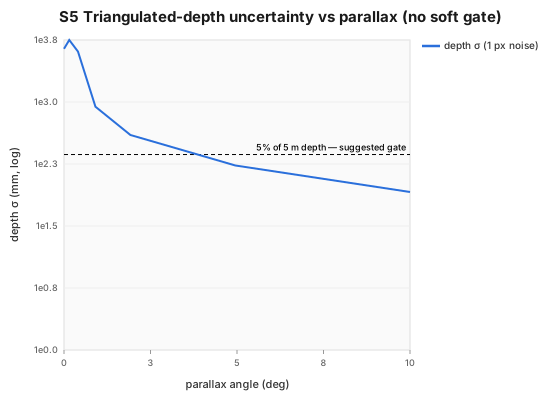
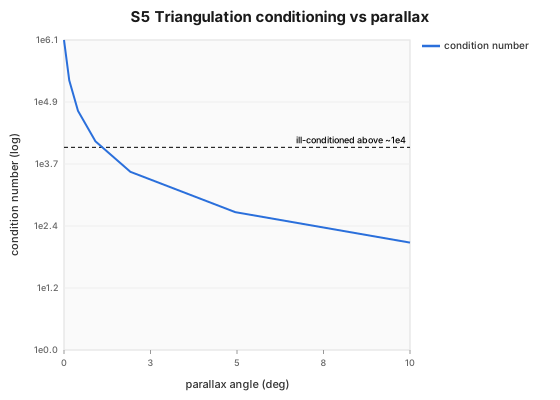
The decisive observation: triangulate() returns success at every level above the
numerical breakdown — including 0.5°, where the depth is uncertain to ~90% of its
value. The always-on guard is the hard one: the Cholesky factorization fails for
near-parallel rays. The soft parallax gate is off by default, so out of the box a
feature triangulated at 0.5–2° parallax is still handed to the update at full weight.
Clean-observation depth error is ~0 throughout (the geometry is correct) — the danger
is entirely in the uncertainty the filter fails to account for.
A reasonable soft gate (depth σ ≤ 5% of depth) sits at ~5° of parallax. Such a
gate is now implemented — CameraUpdaterOptions::min_parallax_deg rejects a
triangulation below the threshold (the S5-gate unit test
confirms it rejects 0.7° and admits 20°), plumbed through VioConfig::min_parallax_deg
and the CORTEX_MIN_PARALLAX_DEG replay knob. It ships default-off (0).
End-to-end on real data — the gate is refuted as the V2_03 fix
Section titled “End-to-end on real data — the gate is refuted as the V2_03 fix”The decisive experiment: enable the gate on EuRoC V2_03 (the aggressive-motion sequence) and measure. It does not help — it monotonically regresses both accuracy and consistency, because gating starves the fast-motion filter of the short-baseline features it depends on:
| V2_03 | gate off | gate 2° | gate 5° |
|---|---|---|---|
| ATE (m) | 0.27 | 0.89 | 1.99 |
| NIS (ideal ≈ dof) | 14.7 | 17.5 | 26.7 |
| NEES (ideal ≈ dim state) | 140 | 170 | 322 |
| updates applied | 21 585 | 16 772 | 10 180 |
The harder the gate, the fewer features survive (a 5° gate drops more than half), and the filter ends up less accurate and more over-confident. So the S5 low-parallax admission — though a genuine contract gap — is not what drives the V2_03 over-confidence; rejecting those features costs more than it saves. The over-confidence is dominated by the other input-side source, the S10 unmodeled calibration. This is the measure-don’t-assume discipline working: a plausible lead, refuted by one experiment.
Real-data inspector (s5_inspect)
Section titled “Real-data inspector (s5_inspect)”The sweep above is the synthetic probe — exact two-view geometry, known parallax,
run in CI. Its real-data companion, s5_inspect, establishes the 3-D
renderer tier (epic #371): it runs the same shipped triangulator
(CameraUpdater::triangulate) on real EuRoC tracks (the shipped FAST + KLT
frontend) with ground-truth clone poses, and renders the 3-D landmark cloud the
camera reconstructs.
s5_inspect --dataset /path/to/V1_01_easy/mav0 --out build/s5 --min-obs 3# --px-noise PX --fast-threshold F --target-features Nnode docs-site/scripts/gen-overlay.mjs build/s5 # → reprojection residuals (per frame)# 3-D landmark cloud + covariance ellipsoids: load scene.json + run.jsonl in the Scene3D viewerTriangulation is decoupled behind the trace::S5Input / trace::S5Output I/O
struct (the clone-pose window + feature tracks in, the landmark cloud out). The
inspector exposes what the update path hides: for each landmark the position
covariance — computed analytically from the operator’s own reprojection
Jacobian, σ² · (Σ Hfᵀ Hf)⁻¹ — plus the inter-view parallax, the system
condition number, and the per-observation reprojection residual. It emits:
scene.json— the landmark cloud + a per-landmark covariance ellipsoid, drawn in the 3-D viewer. A low-parallax feature shows the intuition directly: its ellipsoid stretches far along the line of sight (depth is the unobservable direction), while a wide-baseline feature is a tight sphere.frames.jsonl— per-frame reprojection residuals over the image (observed pixel vs the landmark’s reprojection), drawn by the overlay renderer; a large, structured residual flags a triangulation the backend should not trust.
Interactive
Section titled “Interactive”Parallax is the apparent motion difference between near and far features as the camera moves — exactly what the depth-coloured landmark cloud in the 3-D viewer shows: near dots sweep faster than far ones. Low parallax is when that sweep is small, and depth becomes unobservable.