S10 — Online Calibration
The camera and IMU are two rigidly-attached sensors. Fusing them requires knowing
exactly how they’re mounted relative to each other (the extrinsic transform
T_CI), how the lens maps rays to pixels (intrinsics + distortion), and how their
clocks line up (the time offset t_d). S10 is about whether the filter treats
those numbers as estimated state with uncertainty — or as perfectly known
constants. The cortex filter does the latter, and this page is the measured case
that doing so is a leading contributor to the filter being over-confident.
What it does
Section titled “What it does”OpenVINS carries the calibration as state, alongside the pose and biases:
- Extrinsics
T_CI ∈ SE(3)— 6 parameters per camera. - Intrinsics + distortion — 8 parameters per camera (radtan).
- Time offset
t_d— 1 parameter per camera.
Their Jacobians enter the measurement Jacobian H_x of the MSCKF
update, so the filter both corrects them online and, more
importantly, carries their uncertainty. The principle is unconditional: even a
filter that does not estimate calibration online must still account for its
uncertainty — by inflating the measurement noise R, or carrying a fixed prior
block — or it treats imperfect calibration as perfect and becomes over-confident.
Why it matters
Section titled “Why it matters”This is the crux of #212. The cortex MSCKF has
no calibration states and no calibration term in the noise budget — the EuRoC
T_CI is taken as truth. Any real mounting error then has nowhere to go: the
filter can’t estimate it away and doesn’t widen its covariance for it, so the
resulting reprojection error is silently absorbed into the state while the
covariance stays tight. That is the textbook recipe for over-confidence.
The contract
Section titled “The contract”| Signature | calibration as state: T_CI (6/cam), intrinsics+distortion (8/cam), t_d (1/cam) |
| What it does | estimates calibration online (its Jacobians enter H_x); or, if fixed, accounts for its uncertainty in R |
| Post / invariants | if estimated: calibration states observable only under sufficient excitation (like accel bias) · if fixed: the assumed-perfect calibration’s true uncertainty must appear somewhere in the noise budget |
| cortex | none of the above — no calibration states, no calibration noise term; T_CI/t_d/intrinsics treated as perfectly known |
Metrics
Section titled “Metrics”The S10 probe measures the hypothesis two ways — an analytic budget and an end-to-end sweep on the real backend.
1. Analytic noise budget — what unmodeled calibration costs in pixels
Section titled “1. Analytic noise budget — what unmodeled calibration costs in pixels”Given a realistic calibration uncertainty, compute the reprojection error it
induces and the equivalent R-inflation. The filter assumes ~4.6 px of image
noise; a single degree of extrinsic error already exceeds that:
| Extrinsic σ (gentle motion) | induced reprojection | equivalent R inflation |
|---|---|---|
| 0.5° | 4.1 px | 1.8× |
| 1.0° | 8.1 px | 4.1× |
| 2.0° | 16 px | 13.2× |
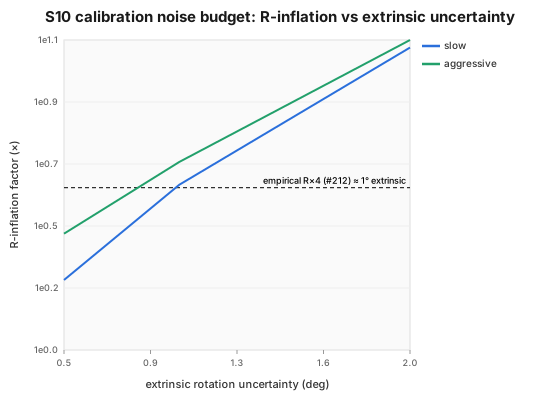
A 1° extrinsic error (entirely realistic for a hand-measured rig) induces ~8 px —
nearly double the assumed noise — for an R-inflation of ~4×. That number
is not a coincidence: it’s the same R×4 the EuRoC troubleshooting found restores
consistency.
2. End-to-end R-inflation sweep — the filter’s measurement-noise deficit
Section titled “2. End-to-end R-inflation sweep — the filter’s measurement-noise deficit”On the synthetic world with perfect calibration and clean sensors, the backend
is already over-confident — pose NEES ≫ dof — reproducing the EuRoC fault in
isolation. Sweeping the measurement-noise variance R and watching NEES return
toward dof = 6 confirms R is the lever:
R scale | pose NEES (target 6) |
|---|---|
| ×1 | 42.6 |
| ×4 | 24.8 |
| ×16 | 10.7 |
| ×32 | 6.09 |
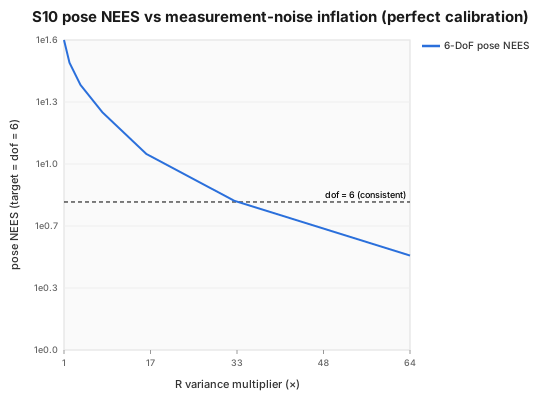
The synthetic backend lands at NEES ≈ 43 at R×1 — almost exactly the EuRoC MH_05 value (~43) — so this clean, ground-truthed setup is reproducing the real over-confidence, not a synthetic artifact.
Real-data inspector (s10_inspect)
Section titled “Real-data inspector (s10_inspect)”The probe above measures the cost of treating calibration as perfectly known.
The real-data companion, s10_inspect, exercises the other S10 path — the
shipped online extrinsic estimator (estimate_extrinsics) that carries the
camera↔IMU extrinsic as state and refines it. It runs the real estimator over a
real EuRoC sequence seeded from a deliberately perturbed extrinsic, and tracks
the in-state estimate converging toward the dataset’s true calibration. No SDK
change — backend().state() exposes the CalibState block.
s10_inspect --dataset /path/to/V1_01_easy/mav0 --out build/s10 --perturb-rot-deg 2 --perturb-trans-mm 30node docs-site/scripts/gen-calibration-figures.mjs build/s10 # → calib_convergence.svgIt writes calibration.json and renders the convergence figure: the
extrinsic-rotation error (deg) and translation error (mm) over time, each inside
the filter’s own ±3σ band, decaying toward the reference (0 error). Seeded a couple
of degrees / centimetres off, a healthy filter pulls the estimate back to truth
while the band shrinks — the in-state remedy for the unmodeled-calibration
over-confidence the probe quantifies. The per-frame error/σ read is unit-tested,
and calib_recovery proves the operator converges on physically-consistent data.
Interactive
Section titled “Interactive”The covariance ellipsoid in the 3-D viewer is this stage made visible: on the sample run the reported position σ collapses to ~13 cm while the true error grows past 2 m. An ellipsoid the ground-truth marker escapes from is the missing calibration uncertainty.