Architecture Overview & Topology
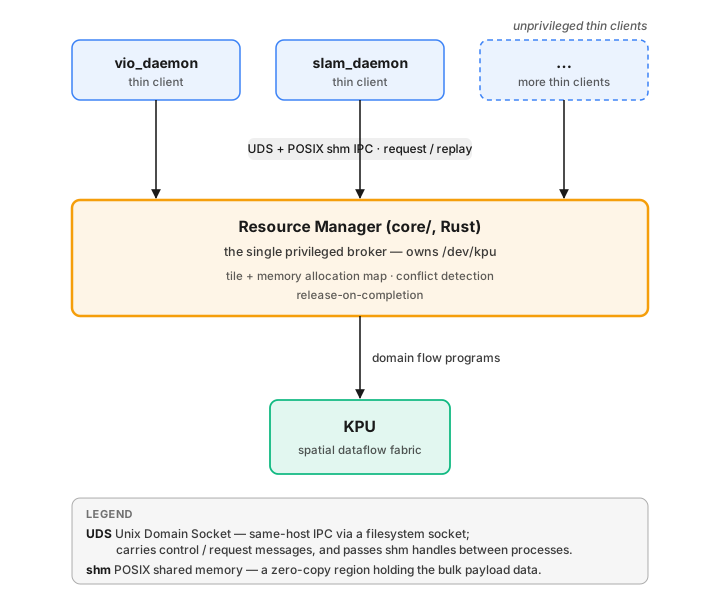
Cortex runs perception on a KPU — a spatial dataflow accelerator — with a host CPU acting as a resource broker. The runtime topology is Host Broker + Thin Client.
Host Broker + Thin Client
Section titled “Host Broker + Thin Client”There is exactly one Resource Manager process with access to /dev/kpu. It owns
the live map of which compiled dataflow programs occupy which physical tiles and
memory regions, performs conflict detection, and releases resources on completion.
Operator containers (the SDK consumers and daemons) are unprivileged thin clients. They never touch hardware directly. They request execution over a Unix Domain Socket + POSIX shared-memory IPC channel, and the broker places the work.
The four surfaces
Section titled “The four surfaces”The architecture deliberately exposes four “surfaces”, from hardware up:
- Resource Manager (
core/, Rust). Owns the HAL and the allocation map. The only privileged component. See Resource Manager. - Math (
math/, header-only C++20). Pure numerics — no I/O, no middleware, no hardware. See the Math Layer. - Operator SDK (
sdk/+cv/, C++20). Builds algorithms (VIO, SLAM) on the math layer; talks to the broker via the cxx bridge. See VIO. - Daemons (
daemons/, C++ executables). The application surface: subscribe to Zenoh, parse YAML config, call the SDK, publish results. Thin by construction.
The strict dependency budget between these surfaces is the subject of Layering Invariants.
Two decisions worth knowing up front
Section titled “Two decisions worth knowing up front”-
The fabric is treated as stateless. Recovery from a broker crash is by client replay, not checkpointing: the SDK’s IPC layer enters a brief “holding pattern” on socket close, then replays pending requests when the broker respawns. There are no disk-based checkpoint paths.
-
No dynamic reconfiguration. Parameter changes go through a managed lifecycle (
Unconfigured → Inactive → Active → teardown). The hot path has no mutex-guarded mutable parameters — an explicit decision to preserve real-time determinism. TheVioEstimatorlifecycle (see VioEstimator) mirrors this.
Delivery
Section titled “Delivery”Cortex is delivered two ways: as OCI containers (the thin clients) and via a Yocto layer (the broker + system integration). The dual strategy keeps operator development container-fast while the production image is a reproducible embedded build.