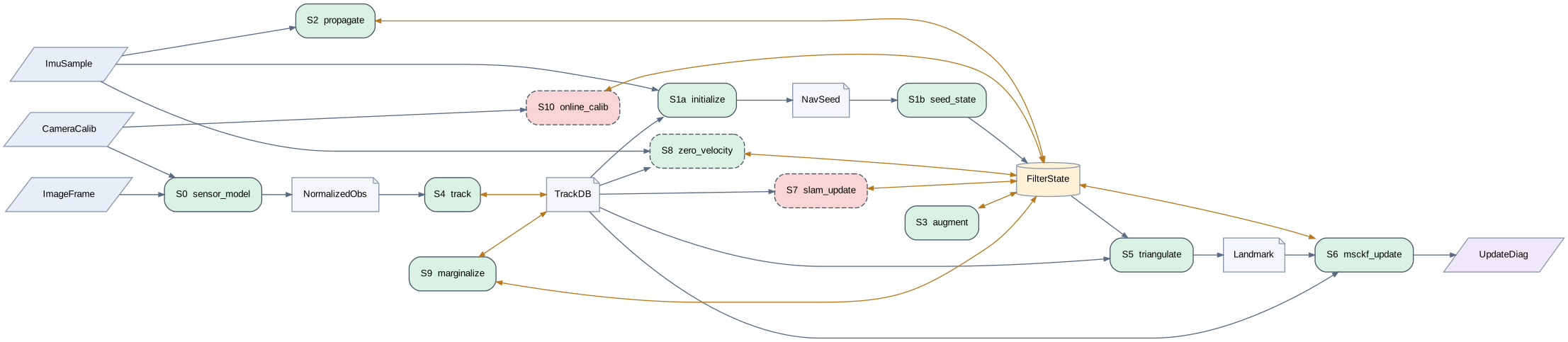
Right-Invariant MSCKF: the transformation graph
The OpenVINS MSCKF with the nav error taken on SE₂(3), right-invariant (R = Exp(δθ)·R̂, v = Exp(δθ)·v̂ + ν, p = Exp(δθ)·p̂ + ρ). Propagation’s Φ then doesn’t depend on the estimate, so the 4-D unobservable subspace is preserved by construction and no update can gain information along it: the property FEJ approximates in the body-frame filter.
A delta on OpenVINS MSCKF: it changes the nodes and data structures listed under Changes from the base, and keeps the rest.
Sources
Section titled “Sources”- mourikis2007 — A. I. Mourikis and S. I. Roumeliotis, “A Multi-State Constraint Kalman Filter for Vision-aided Inertial Navigation”, ICRA 2007.
- li2013 — M. Li and A. I. Mourikis, “High-precision, consistent EKF-based visual-inertial odometry”, IJRR 32(6), 2013 (MSCKF 2.0, first-estimates Jacobians).
- geneva2020 — P. Geneva, K. Eckenhoff, W. Lee, Y. Yang and G. Huang, “OpenVINS: A Research Platform for Visual-Inertial Estimation”, ICRA 2020.
- huang2010 — G. P. Huang, A. I. Mourikis and S. I. Roumeliotis, “Observability-based Rules for Designing Consistent EKF SLAM Estimators”, IJRR 29(5), 2010.
- barrau2017 — A. Barrau and S. Bonnabel, “The Invariant Extended Kalman Filter as a Stable Observer”, IEEE TAC 62(4), 2017.
- hartley2020 — R. Hartley, M. Ghaffari, R. M. Eustice and J. W. Grizzle, “Contact-aided invariant extended Kalman filtering for robot state estimation”, IJRR 39(4), 2020 (the right-invariant IMU error dynamics on SE₂(3)).
Transformations
Section titled “Transformations”Each has the shape (state, inputs, params) → (state′, diagnostics).
| Stage | Node | Does | Reads → writes | Paper | Status | Code | Bench |
|---|---|---|---|---|---|---|---|
| S0 | sensor_model | pixel → normalized image point (undistort, unproject) | ImageFrame, CameraCalib → NormalizedObs | geneva2020, camera models | implemented | sdk/include/branes/sdk/msckf/stages/s0_sensor_model.hpp | tests/tools/stage_bench_s0_s1.cpp “S0 bench: every fixture passes in every type…” |
| S4 | track | image → feature tracks (FAST + KLT), and the tracks that ended | NormalizedObs, TrackDB → TrackDB | geneva2020, visual tracking | implemented | sdk/include/branes/sdk/msckf/stages/s4_frontend.hpp | tests/tools/stage_bench_s4_s5.cpp “S4 bench: every fixture passes for every variant…” |
| S1a | initialize | an IMU window at rest (static), or a moving window of frames (dynamic VI alignment) → the nav seed | ImuSample, TrackDB → NavSeed | geneva2020, initialization | implemented | sdk/include/branes/sdk/imu_init.hpp | tests/tools/stage_bench_s0_s1.cpp “S1 bench: static paths pass every fixture…” |
| S1b | seed_state | the seed’s mean as it is (velocity included); the base’s body-frame prior mapped into the right-invariant error, P₀ = J·P_body·Jᵀ with δθ_world = R̂·δθ_body, ν = δv + [v̂]×δθ_world, ρ = δp + [p̂]×δθ_world | NavSeed → FilterState | barrau2017, the invariant error | implemented | tools/include/branes/tools/invariant_backend_adapter.hpp | — |
| S2 | propagate | one IMU interval (the samples at both of its ends) → the propagated SE₂(3) mean; P ← Φ P Φᵀ + L Lᵀ with Φ independent of the estimate | FilterState, ImuSample → FilterState | hartley2020, the right-invariant IMU error dynamics | implemented | sdk/include/branes/sdk/msckf/invariant_propagator.hpp | tests/tools/stage_bench_s2_s3.cpp “S2 bench: the invariant error maps the body-frame gauge…” |
| S3 | augment | the state → the state plus a clone sharing the nav’s δθ and ρ, P′ = G P Gᵀ | FilterState → FilterState | mourikis2007, §III-B, stochastic cloning, in the invariant error | implemented | sdk/include/branes/sdk/msckf/msckf_invariant_backend.hpp | — |
| S5 | triangulate | an ended track and the invariant clones → the feature position, linear then Gauss-Newton | TrackDB, FilterState → Landmark | mourikis2007, §III-C | implemented | sdk/include/branes/sdk/msckf/invariant_update.hpp | — |
| S6 | msckf_update | track + landmark → the invariant H (nav columns zero) → null-space projection → χ² gate → EKF update, right-invariant retraction | FilterState, TrackDB, Landmark → FilterState, UpdateDiag | barrau2017, the invariant measurement update | implemented | sdk/include/branes/sdk/msckf/msckf_invariant_backend.hpp | — |
| S9 | marginalize | the state → the state without its oldest clone, after fusing every track that touches it | FilterState, TrackDB → FilterState, TrackDB | mourikis2007, §III-E | implemented | sdk/include/branes/sdk/msckf/invariant_vio_backend.hpp | — |
| S8 | zero_velocity | at rest → v = 0 in the invariant error (H_θ = −[v̂]×, H_ν = I, r = −v̂) and b_g = ω̄; the frame adds no clone | FilterState, ImuSample, TrackDB → FilterState | geneva2020, zero-velocity update | implemented (optional) | sdk/include/branes/sdk/msckf/msckf_invariant_backend.hpp | — |
| S7 | slam_update | long-lived features kept in the state as landmarks and updated every frame | FilterState, TrackDB → FilterState | geneva2020, SLAM features | missing (optional) | — | — |
| S10 | online_calib | the state ⊕ camera↔IMU extrinsics; MsckfInvariantBackend::enable_calibration exists, the EuRoC adapter doesn’t call it | FilterState, CameraCalib → FilterState | geneva2020, online calibration | missing (optional) | — | — |
Contracts
Section titled “Contracts”sensor_model (S0, Sensor model)
- Pre: intrinsics valid; the pixel inside the image
- Post: project ∘ unproject is the identity; the analytic Jacobian matches finite differences
- Test:
tests/sdk/msckf_stages.cpp“S0_sensor_model normalizes a pixel…”
track (S4, Visual front end)
- Pre: consecutive frames; features detected inside the trackable band
- Post: tracks inside the image; forward-backward error bounded; ended tracks released in id order
- Test:
tests/sdk/msckf_stages.cpp“S4_frontend ingests observations…” - Deviates from the paper: no RANSAC outlier rejection in the front end; the S6d gate carries it
- Deviates from the paper: the shipped default churns (>50% of new tracks lost on their first frame); the border margin is opt-in (#474, #574)
initialize (S1a, Initialization)
- Pre: an IMU window that is at rest, or frames with enough excitation and parallax
- Post: gravity-aligned attitude; the method is recorded
- Test:
tests/sdk/imu_init.cpp“static init recovers gravity…” - Test:
tests/sdk/msckf_dynamic_init.cpp“the backend bootstraps a moving start via dynamic VI init…” - Deviates from the paper: the dynamic path is excitation-limited on EuRoC and has open SfM defects (#254, #499–#501)
seed_state (S1b, Seed the filter in the invariant error)
- Pre: a successful seed from the base’s initialize
- Post: the mean equals the seed; P₀ = J·P_body·Jᵀ, positive-definite; the IMU sample in effect at the seed time is held, so propagation resumes at the seed time
- Test:
tests/tools/invariant_backend_adapter.cpp“invariant adapter: the body-to-invariant map matches the exact error…” - Test:
tests/tools/invariant_backend_adapter.cpp“invariant adapter: initializes through the shipped MSCKF with its seed…” - Deviates from the paper: the base’s prior is itself an isotropic σ = 0.1 with no tilt-bias correlation (#609); this node maps it faithfully
propagate (S2, Invariant IMU propagation)
- Pre: Δt > 0 and bounded
- Post: R ∈ SO(3); P symmetric PSD; Φ preserves the gauge null space at any state
- Test:
tests/sdk/invariant_propagator.cpp“invariant propagation: Phi preserves the gauge null space at any state…” - Test:
tests/sdk/invariant_propagator.cpp“invariant propagation: the predicted covariance matches a Monte-Carlo…” - Decision — the IMU input over each interval and the mean’s integrator: the base’s: both samples interpolated linearly, integrated by RK4 (#616) over the sample that starts the interval, held (#608 to #616). the mean is the same strapdown physics in either error convention, and one convention for both backends keeps a time-offset state (#332) from learning a backend-specific skew
- Decision — Φ and L over the interval: unchanged: Φ’s nav block does not depend on the input, and its bias lever arms are taken at the start of the interval over lever arms at the interval’s midpoint. the lever-arm terms move by v·Δt over 5 ms, far below what the update resolves; the gauge test holds at any state
augment (S3, Invariant augmentation)
- Pre: the state propagated to the image time
- Post: P grows by 6 with an exact block copy; P PSD
- Test:
tests/sdk/invariant_joint_step_fd.cpp“DIAG FD: augmentation G under rotation…” - Test:
tests/sdk/msckf_invariant_backend.cpp“invariant backend: propagate + augment + update runs and stays PSD…”
triangulate (S5, Invariant triangulation)
- Pre: at least two observations from live clones
- Post: positive depth in every camera; a low-parallax linear solve repaired by refinement
- Test:
tests/sdk/invariant_update.cpp“invariant triangulation: Gauss-Newton refinement repairs…”
msckf_update (S6, Invariant MSCKF update)
- Pre: the landmark triangulated against the current clones
- Post: H annihilates the 4-DoF gauge at the actual clone poses; P⁺ ⪯ P⁻; a non-finite δx is rolled back
- Test:
tests/sdk/invariant_update.cpp“invariant update: H annihilates the 4-DoF gauge…” - Test:
tests/sdk/msckf_invariant_backend.cpp“invariant backend: the marginalized joint update annihilates the 4-DoF gauge…” - Test:
tests/sdk/invariant_joint_step_fd.cpp“DIAG FD: measurement-update linearization (proj.r vs -H*e)…” - Test:
tests/sdk/invariant_zero_velocity.cpp“invariant backend: every update reports its NIS, gated or not…” - Test:
tests/sdk/invariant_zero_velocity.cpp“invariant backend: the chi-square gate needs alpha in (0,1)…”
marginalize (S9, Marginalization (invariant backend))
- Pre: every track touching the clone has been fused
- Post: P is the principal submatrix; no observation refers to the dropped clone
- Test:
tests/sdk/invariant_vio_backend.cpp“invariant VIO backend: end-to-end integration over a seed sweep…”
zero_velocity (S8, Invariant zero-velocity update)
- Pre: both the IMU and the image tests say rest (the base’s detector)
- Post: the posterior equals the Kalman update with H from finite differences of the retraction
- Test:
tests/sdk/invariant_zero_velocity.cpp“invariant S8: the zero-velocity posterior matches the retraction’s Jacobian…” - Test:
tests/sdk/invariant_zero_velocity.cpp“invariant S8: the gyro-bias update is the additive Kalman update…” - Test:
tests/tools/invariant_backend_adapter.cpp“invariant adapter: S8 holds a frame at rest out of the window…”
Data structures
Section titled “Data structures”| Edge | Kind | Contents | Type | Invariants (✓ has a validator) |
|---|---|---|---|---|
| ImuSample | input | t, angular rate ω (rad/s), specific force a (m/s²) | sdk/include/branes/sdk/vio_backend.hpp ImuMeasurement | ✓ timestamps strictly increasing; ✓ Δt within the sensor-rate bounds; ✓ samples finite |
| ImageFrame | input | t, 8-bit image, camera id | sdk/include/branes/sdk/vio_estimator.hpp feed_image | ✗ t increasing and inside the IMU span; ✗ the image matches the calibration’s resolution |
| CameraCalib | input | intrinsics (fx, fy, cx, cy), radtan distortion, camera↔IMU extrinsic (R_imu_cam, p_imu_cam) | math/include/branes/math/cameras/pinhole_radtan.hpp PinholeRadtanCamera | ✓ R_imu_cam ∈ SO(3); ✓ intrinsics positive, principal point inside the image |
| NormalizedObs | data | feature id, camera id, normalized image point (x, y) | sdk/include/branes/sdk/msckf/stages/s0_sensor_model.hpp Result | ✗ finite, and the ray is in front of the camera (z > 0) |
| TrackDB | data | feature id → [(clone time, normalized observation)], plus the tracks that ended this frame | sdk/include/branes/sdk/msckf/stages/s4_frontend.hpp TrackTable | ✗ every observation’s clone time is a live clone, or the observation is purged; ✓ points inside the image; ✓ track length at most the clone window |
| NavSeed | data | R, v, p, b_g, b_a, the time, and the prior P₀ in the filter’s error convention | sdk/include/branes/sdk/msckf/stages/s1_initialization.hpp seed_from_imu | ✓ gravity sign and magnitude; ✓ P₀ symmetric positive-definite; ✗ P₀ states what the init window does and does not determine (tilt-bias correlation) |
| FilterState | state | nav on SE₂(3) with additive biases (θ, ν, ρ, b_g, b_a: 15), clones (θ, ρ: 6 each) in the same right-invariant error, the joint covariance P | sdk/include/branes/sdk/msckf/invariant_propagator.hpp InvariantNavState | ✓ P symmetric; ✓ P positive semidefinite; ✓ R and every clone rotation ∈ SO(3); ✗ every Jacobian and retraction uses R = Exp(δθ)·R̂, v = Exp(δθ)·v̂ + ν, p = Exp(δθ)·p̂ + ρ |
| Landmark | data | feature position p_f (world), the triangulation’s parallax and conditioning | sdk/include/branes/sdk/msckf/stages/s5_triangulation.hpp Result | ✓ positive depth in every observing camera; ✓ normal-matrix condition number reported |
| UpdateDiag | output | NIS, dof, the gate verdict, and where a rejected track stopped | sdk/include/branes/sdk/msckf/stages/s6_msckf_update.hpp Result | ✓ NIS ~ χ²(dof) over windows (bound χ²₁₋α(dof) per update, α = 0.05, from what msckf_update resolves: the S6d gate rejects above it, so a consistent filter loses α of its inliers and no more) |
- ImageFrame precision: integer pixels; no arithmetic-type choice
- NormalizedObs precision: the narrowest edge that keeps sub-pixel accuracy; float holds (#532)
- NavSeed deviates from the paper: P₀ is an isotropic σ = 0.1 on every core state, with no tilt-bias correlation (#609)
- FilterState precision: stored in double; the Joseph form on EuRoC (the square-root form diverges there)
Schedule
Section titled “Schedule”The driver is tools/include/branes/tools/invariant_backend_adapter.hpp.
on imu (200 Hz): initialize [when not initialized] — the base's initializer seed_state [when a seed is ready] propagate [when initialized] — the base's interval convention: both samples, RK4 (#616)on image (20 Hz): sensor_model track initialize [when not initialized] — try the dynamic VI alignment seed_state [when a seed is ready] — then return propagate — to the image time zero_velocity [when at rest] — then return; the frame adds no clone msckf_update for each track touching the oldest clone [when window full] marginalize [when window full] augment triangulate for each ended track (ascending id) msckf_update for each ended track (ascending id)System invariants
Section titled “System invariants”| Invariant | Check | Status |
|---|---|---|
| NEES ≈ dim(state) against ground truth (consistency) | tools/include/branes/tools/pose_consistency.hpp PoseConsistency | unknown — consistent on ideal EuRoC tracks (yaw ANEES 1.26); on real KLT tracks not yet measured (#365) |
| NIS ≈ dim(measurement) per update | sdk/include/branes/sdk/msckf/invariant_vio_backend.hpp nis_consistency | failing — real KLT tracks: normalized NIS 0.97–2.55 on MH, V1_01 and V2_01; 6.8–15.4 on V1_02, V1_03, V2_02 and V2_03 (#608) |
| innovations zero-mean and white | sdk/include/branes/sdk/msckf/invariant_vio_backend.hpp innovation_whiteness | unknown — reported since #608 |
| no information gained along global yaw and translation (the 4-D unobservable space) | tests/sdk/msckf_invariant_backend.cpp “invariant backend: the marginalized joint update annihilates the 4-DoF gauge…” | holds |
| told the true noise, the filter improves and its yaw σ never collapses (EuRoC ideal tracks) | scripts/euroc-consistency.sh | failing — with one truth and S2 integrating both samples (#616, median NIS 1.00): fails 1 (2 of 66 at 1 px, MH_03 and MH_04, the same draws as the MSCKF: the shared tilt and bias seed, #609), passes 2 (0.40× vs 0.41×; 0.18× vs 0.36×), passes 3 (0.984) |
| 4-DoF ATE and rotation RPE within a factor of OpenVINS mono on the 11 EuRoC sequences | scripts/euroc-baseline.sh | failing — median 2.62× OpenVINS mono (the MSCKF 2.83×; 7 of 11 sequences better); rotation RPE 0.90° vs 2.21° (#608) |
Changes from the base
Section titled “Changes from the base”- replace edge FilterState: the error convention changes; every consumer is revisited below
- replace node seed_state: #608
- replace node propagate
- replace node augment
- replace node triangulate
- replace node msckf_update: #608: the base’s χ²₁₋α(dof) gate (#481), and the NIS and innovation sum of every update
- replace node marginalize: a principal submatrix is the same in any error convention; the track bookkeeping is the invariant backend’s own
- replace node zero_velocity: #608
- replace node online_calib
- kept base node slam_update on changed edge FilterState: not implemented in either filter
Gap report
Section titled “Gap report”What pipeline_graph.py gaps reports for this spec (22 items):
- edge ‘ImageFrame’: no validator for “t increasing and inside the IMU span”
- edge ‘ImageFrame’: no validator for “the image matches the calibration’s resolution”
- edge ‘NormalizedObs’: no validator for “finite, and the ray is in front of the camera (z > 0)”
- edge ‘TrackDB’: no validator for “every observation’s clone time is a live clone, or the observation is purged”
- edge ‘NavSeed’: no validator for “P₀ states what the init window does and does not determine (tilt-bias correlation)”
- edge ‘NavSeed’: deviates from the paper: P₀ is an isotropic σ = 0.1 on every core state, with no tilt-bias correlation (#609)
- edge ‘FilterState’: no validator for “every Jacobian and retraction uses R = Exp(δθ)·R̂, v = Exp(δθ)·v̂ + ν, p = Exp(δθ)·p̂ + ρ”
- node ‘track’: deviates from the paper: no RANSAC outlier rejection in the front end; the S6d gate carries it
- node ‘track’: deviates from the paper: the shipped default churns (>50% of new tracks lost on their first frame); the border margin is opt-in (#474, #574)
- node ‘initialize’: deviates from the paper: the dynamic path is excitation-limited on EuRoC and has open SfM defects (#254, #499–#501)
- node ‘seed_state’: no stage bench
- node ‘seed_state’: deviates from the paper: the base’s prior is itself an isotropic σ = 0.1 with no tilt-bias correlation (#609); this node maps it faithfully
- node ‘augment’: no stage bench
- node ‘triangulate’: no stage bench
- node ‘msckf_update’: no stage bench
- node ‘marginalize’: no stage bench
- node ‘zero_velocity’: no stage bench
- node ‘slam_update’ (S7): not implemented
- node ‘online_calib’ (S10): not implemented
- system invariant ‘nis’: failing — real KLT tracks: normalized NIS 0.97–2.55 on MH, V1_01 and V2_01; 6.8–15.4 on V1_02, V1_03, V2_02 and V2_03 (#608)
- system invariant ‘consistency_gate’: failing — with one truth and S2 integrating both samples (#616, median NIS 1.00): fails 1 (2 of 66 at 1 px, MH_03 and MH_04, the same draws as the MSCKF: the shared tilt and bias seed, #609), passes 2 (0.40× vs 0.41×; 0.18× vs 0.36×), passes 3 (0.984)
- system invariant ‘accuracy’: failing — median 2.62× OpenVINS mono (the MSCKF 2.83×; 7 of 11 sequences better); rotation RPE 0.90° vs 2.21° (#608)