Consistency Analysis
This is the deep-dive behind the MSCKF update: how the filter’s over-confidence was localized by measurement rather than guesswork. It is the worked example of the method — drive a well-defined knob, read the consistency instrument, not end-to-end ATE.
The symptom the instrument exposed
Section titled “The symptom the instrument exposed”The MSCKF is systemically over-confident on every sequence — invisible to ATE, which looked fine (sub-metre on the well-tracked runs):
| sequence (static init) | ATE | NIS (target 1) | NEES (target 1) |
|---|---|---|---|
| MH_05_difficult | 0.79 m | 2.2 | 10 |
| V2_03_difficult | 0.29 m | 14.8 | 115 |
Per-block NEES localized it to attitude, worst under fast rotation (V2_03 attitude NEES 169 vs position 3.5). Crucially, the over-confidence scales with motion aggressiveness — the first hint of a linearization/observability cause rather than a constant mistune.
The three sweeps
Section titled “The three sweeps”Two runtime knobs (no rebuild) drove the diagnosis: CORTEX_Q_SCALE multiplies the
IMU process-noise densities, CORTEX_R_SCALE the visual measurement noise.
Q — process noise is ~10× too small
Section titled “Q — process noise is ~10× too small”| Q scale | V2_03 NEES | V2_03 NIS | MH_05 NEES |
|---|---|---|---|
| 1 | 115 | 14.8 | 10.1 |
| 10 | 7.95 | 12.9 | 4.86 |
| 30 | 17.7 | 11.3 | 7.17 |
NEES has a clear minimum at Q≈10 — the IMU densities are an order of magnitude
under-sized. But NIS barely moves (14.8 → 11.3 across 30×): inflating P via
Q does not fix the innovation over-confidence. Two independent faults.
R — measurement noise is ~4× too small, and it is holding the filter up
Section titled “R — measurement noise is ~4× too small, and it is holding the filter up”| R scale | V2_03 ATE | V2_03 NIS | MH_05 NIS |
|---|---|---|---|
| 1 | 0.29 m | 14.8 | 2.18 |
| 4 | 2.07 m | 1.08 | 0.15 |
| 10 | 278 m | 0.36 | 0.04 |
NIS scales as a near-perfect 1/R² (14.8 → 3.9 → 1.08) — the signature of an
under-tuned measurement noise, not an observability wall (which wouldn’t scale
away). But making R honest diverges the filter: ATE goes 0.29 m → 2 m → 278 m.
The over-tight R is supplying the correction authority that keeps the trajectory
bounded. The default config has good ATE and a lying covariance because two errors
(tight Q, tight R) are mutually compensating.
Joint — no setting is both consistent and accurate
Section titled “Joint — no setting is both consistent and accurate”| Q | R | seq | ATE | NIS | NEES |
|---|---|---|---|---|---|
| 1 | 1 | V2_03 | 0.29 | 14.8 | 115 |
| 10 | 2 | V2_03 | 0.83 | 3.6 | 10.1 |
| 10 | 4 | V2_03 | 6.22 | 1.06 | 42 |
| 1 | 1 | MH_05 | 0.79 | 2.2 | 10 |
| 10 | 4 | MH_05 | 3.04 | 0.15 | 3.6 |
Read down the ATE column: every step toward an honest covariance costs accuracy. The most accurate config is the most over-confident; the most consistent configs carry 3–6 m ATE.
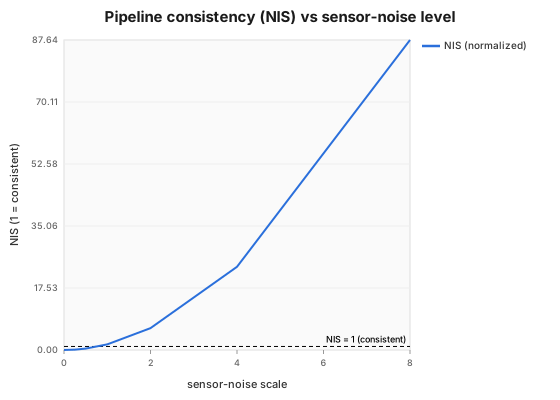
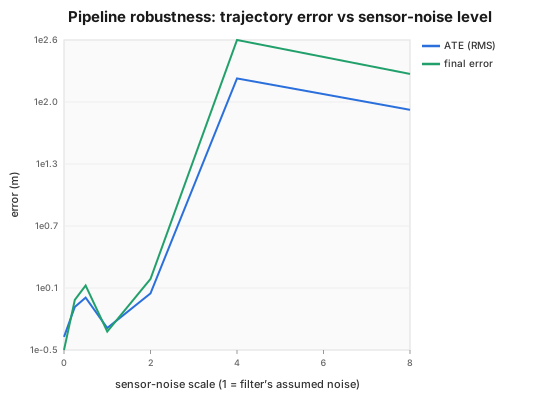
The same relationship is visible cleanly on the synthetic world, where ground truth is exact — NIS crosses 1 right where the injected noise matches the model, and ATE holds until the filter loses lock:
Why this is structural, not a re-tune
Section titled “Why this is structural, not a re-tune”In a correctly-modelled filter the true noise values give consistency and optimal accuracy simultaneously — that is the definition of optimality. Here, accuracy requires over-confident noise, so a structural error is being masked by the over-confidence; relax the noise and the underlying error surfaces as drift.
The fault is motion-dependent — attitude NEES, NIS, and the residual inconsistency at honest noise all scale with aggressiveness. That fingerprints an EKF observability / linearization inconsistency (the classic MSCKF spurious-information-gain in the unobservable yaw + position directions).
The discriminator — innovation whiteness
Section titled “The discriminator — innovation whiteness”One clean test separates “observability inconsistency” from “a systematic bias (calibration / triangulation / time-sync)”: the mean and whiteness of the normalized innovations.
| sequence | mean z | bias magnitude | lag-1 z | verdict |
|---|---|---|---|---|
| V2_03 (aggressive) | −4.64 | ≈ −0.013σ (~0.1 px) | +14.2 | non-white; bias negligible |
| MH_05 (mild) | +2.19 | — | −10.3 | non-white; zero-mean |
The innovations are strongly non-white on both sequences (|lag-1 z| ≫ 2.58) — the filter leaves temporal structure in the residuals, the signature of an observability/linearization inconsistency. The mean is effectively zero (no gross calibration error). At the time, this pointed squarely at First-Estimates Jacobians (FEJ) / OC-EKF as the fix.
What the FEJ experiment then revealed
Section titled “What the FEJ experiment then revealed”The current reading is therefore multi-source, not a single bug:
- Unmodeled calibration (S0 /
S10) — a variance deficit with no
mean bias, accounting for the
R×4component. Leading. - Process noise
Q(S2) — theQ×10that helps on EuRoC. But the S2 probe shows propagation-only NEES is consistent at the shippedQ, so this is compensating inflation masking the structural error, not a genuine propagation defect. (Its diagonal-Qsimplification is real but costs <1% per frame.) - Missing parallax gate (S5) — measured: no soft gate, low-parallax features admitted at full weight; implicated in the V2_03 divergence.
The full, current decomposition and the tracking issues live on Engineering Status.
Reproduce it
Section titled “Reproduce it”cmake --preset sitl-release && cmake --build --preset sitl-release --target vio_euroc -j4export CORTEX_EUROC_MH05=/path/to/MH_05_difficult/mav0export CORTEX_EUROC_V203=/path/to/V2_03_difficult/mav0CORTEX_Q_SCALE=10 CORTEX_R_SCALE=2 \ ./build/sitl-release/tests/vio_euroc "V2_03_difficult replay (moving start) converges"The benchmark WARNs the aggregate NEES/NIS, the per-block NEES, and the active scale factors. Use the Release binary — it replays a sequence in ~85 s vs ~25× slower unoptimized.