S4 — Visual Frontend
The frontend turns raw images into the feature tracks the backend consumes: detect corners, follow them frame-to-frame, and reject the ones that don’t hold up. Its job is to hand the backend correspondences that are correct — no backend trick repairs a confidently-wrong match — and to report the true pixel noise on the ones that survive. The probe drives the shipped FAST detector + pyramidal KLT on synthetic textured imagery warped by a known translation.
What it does
Section titled “What it does”FAST detection with grid-bucketed coverage and min-distance suppression; pyramidal KLT tracking frame-to-frame (the IMU gyro prior can seed the search); and — per the canonical contract — a forward-backward consistency check and RANSAC on the epipolar constraint to drop outliers before the backend.
The contract
Section titled “The contract”| Signature | track(image_t, prev_tracks) → observations[(id, cam, u, v)] |
| Pre | image in expected format; previous tracks available; (optional) gyro rotation prior |
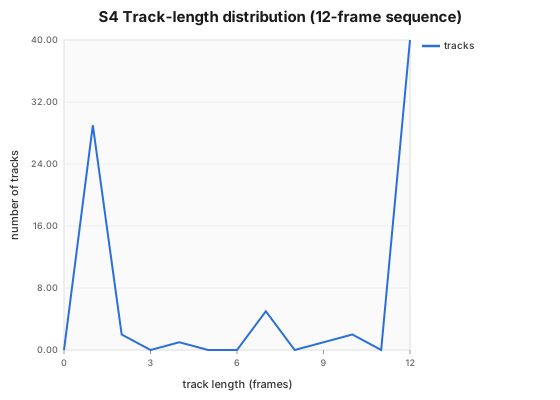
| Post / invariants | every surviving track passes forward-backward (round-trip pixel error < τ) · RANSAC inlier ratio above a floor; outliers removed before the backend · spatial coverage across the image grid · track-length distribution healthy (not all length-2 — that starves parallax) |
| cortex | frontend in vio_estimator.hpp (FrontendParams); pyramidal KLT (cv/klt.hpp), FAST (cv/fast.hpp) |
For the API-level treatment of the tracker, see the Visual Front End reference.
Metrics
Section titled “Metrics”The S4 probe detects FAST corners on a textured pattern, then tracks A→B and B→A with the shipped KLT to measure self-consistency.
| metric | value | note |
|---|---|---|
| features detected (FAST) | 80 | level-0 corners |
| forward-tracked (KLT) | 51 / 80 | status = Tracked |
| forward-backward residual (median) | 0.0016 px | tracks are self-consistent |
| endpoint RMS (all backward-tracked) | 0.001 px | the un-gated frontend’s actual error |
| RANSAC inlier ratio | n/a | RANSAC not shipped — no geometric gate applied |
| grid coverage occupancy | 100 % | 8×6 grid — well distributed |
| mean track length | 7.3 frames | over a 12-frame sequence |
The shipped primitives are sound: near-zero forward-backward residual, sub-pixel endpoint accuracy, full grid coverage, and healthy track lengths.
Pixel-noise → track-noise
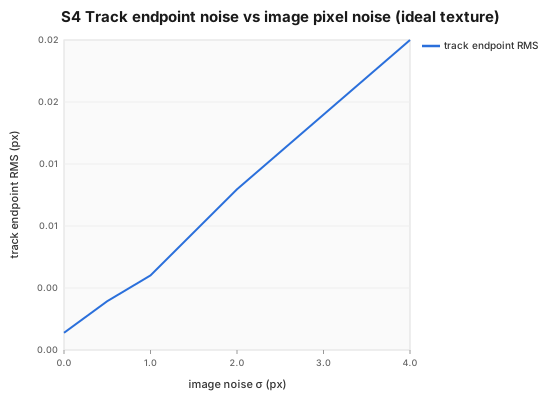
Section titled “Pixel-noise → track-noise”Sweeping image noise, the recovered-track endpoint error scales roughly linearly with the image noise:
Real-data inspector (s4_inspect)
Section titled “Real-data inspector (s4_inspect)”The metrics above come from the synthetic probe — known warps, exact ground
truth, run in CI. Its real-data companion, s4_inspect, runs the same shipped
operator (FAST + pyramidal KLT, mirroring track_frame) on actual EuRoC cam0
frames and renders the result, so you can watch the frontend on real motion, blur,
and repetitive texture.
s4_inspect --dataset /path/to/V1_01_easy/mav0 --out build/s4# --fast-threshold --target-features --pyramid-levels --fb-max --min-distnode docs-site/scripts/gen-overlay.mjs build/s4 # → build/s4/frames/*.svgIt writes frames.jsonl, one record per frame, carrying per track the
previous→current pixel, the forward-backward residual, age, and status, plus
the FAST detections, the pyramid geometry, and a coverage grid. The overlay draws
these over the EuRoC image: KLT flow vectors coloured by FB residual, new
detections, the coverage grid, a pyramid schematic, and a count HUD.
Crucially — and unlike both the probe and the production path — s4_inspect
always computes the forward-backward residual, even when the gate is disabled.
That lets you see exactly which tracks a gate would cull on real imagery before
committing to enabling fb_max_residual (below). It is the template member of the
trace-tapped, real-data inspector family (epic #371); see tools/README.md.
The S4 candidate — the outlier gate
Section titled “The S4 candidate — the outlier gate”By default the frontend applies only KLT’s own Lost/OutOfBounds status
filter — no forward-backward check, no RANSAC. On real data a track that drifts
onto repetitive texture or across an occlusion follows KLT to a
confidently-wrong location and reaches the
backend at full weight — the same
“optimistic information” failure mode as the
S5 parallax gate.
A forward-backward gate is now implemented — FrontendParams::fb_max_residual
re-tracks each survivor back to the previous frame and drops it if the round-trip
error exceeds the threshold (the S4-gate unit test
confirms a strict gate drops every drifted track while a disabled gate keeps them).
It ships default-off and doubles the per-frame KLT cost when enabled, so it
awaits end-to-end validation before being turned on. (RANSAC remains future work —
it needs an essential-matrix solver not yet in the codebase.)