ADR 0008 — Host Broker + Thin Client runtime topology
Status: Accepted
Date: 2026-05-20
Source: docs/arch/cortex-repo.md, The “Host Broker + Thin Client” Topology
Related: ADR-0004, ADR-0009; issue #21
Context
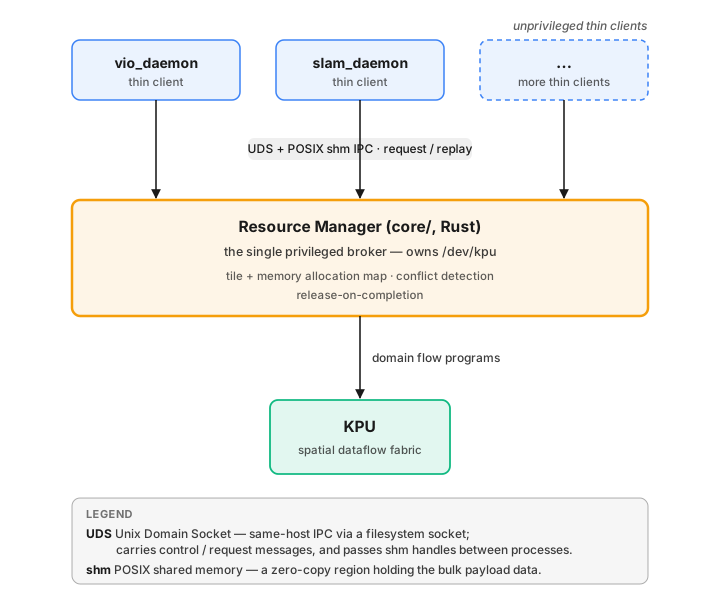
Section titled “Context”Several operator processes (VIO, SLAM, segmentation, …) need the KPU at the same time. Because allocation on the KPU is tied to each operator’s spacetime footprint (ADR-0004), letting processes open the driver independently would let them corrupt each other’s allocations.
Decision
Section titled “Decision”- Exactly one Resource Manager (Rust,
core/) runs as a privileged host service (e.g.systemd). It is the only process with access to/dev/kpuand the physical DMA memory pools, and it holds the global allocation map. - Operator processes are unprivileged thin clients. They request
execution over a Unix domain socket plus POSIX shared memory IPC
channel and get zero-copy shared-memory results back. The SDK wraps those
buffers as
std::spanand never sees the hardware.
Request flow: client asks to run a domain flow program → RM checks its allocation map and either places it spatially beside other work or holds it until the fabric frees → RM configures DMA and triggers the KPU → RM hands the shared-memory result back.
Consequences
Section titled “Consequences”- Never give an SDK consumer or daemon direct hardware access, and never
add a code path that opens
/dev/kpuoutsidecore/. - The RM sees every in-flight request, so it can enforce dependencies (hold SLAM until VIO’s allocation is released) and avoid conflicts globally.
- The RM is a single point of failure. ADR-0009 makes it cheap to restart.
- Current state: the SITL memory provider emulates the hardware with POSIX shared memory; the IPC broker is issue #21.